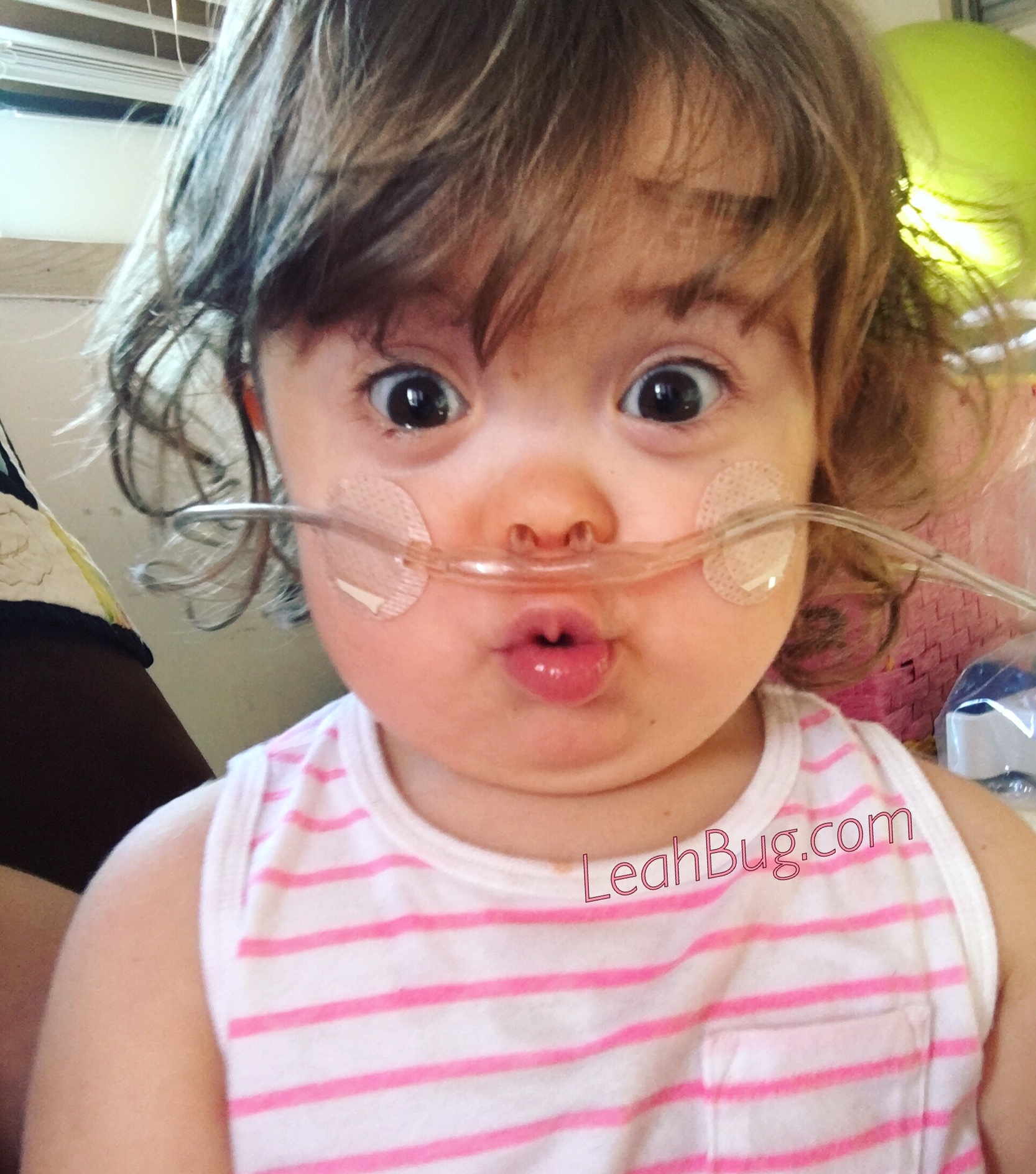
I got three separate questions that can be folded into one response:
1) “What types of physical or mental conditions often accompany Down syndrome? And is there any difference in life expectancy because of Down itself?”
2) “Has anyone asked yet what Leah’s life expectancy might be? I know there’s no such thing as “typical”, especially when there are other factors besides T21 involved.”
3) “What characteristics are true of all/most Downs kids vs what things … Leah deals with [that] are due to another diagnosis or just to her uniqueness.”
Let me get the life expectancy question out of the way first, because it is the toughest to answer. Over the past few years I’ve had multiple people ask me, “So, is Leah out of the woods now?” And the truth is that with Down Syndrome, there is no such thing. We live in the woods. The woods never go away. A simple cold can be life-threatening. Pneumonia is common in our kids and hard to fight off. A tiny infection can lead to sepsis. Leukemia can strike at any time. I know too many parents whose children are no longer with them to speculate on Leah’s life expectancy. We take nothing for granted.
That being said, I will say that the *average* life expectancy of a person with Down Syndrome has doubled in the past fifty years or so, from about 25 to about 50. I would attribute that jump to two main factors: 1) improvements in pediatric cardiology and improved overall survival rates among infants with heart defects, and 2) deinstitutionalization. Living in the community and/or with your family translates to a longer life expectancy compared to living in a nursing home.
[Edit: Two corrections. First, average life expectancy is actually 60, not 50. But second, it’s important to note that the average life span for white people with Down Syndrome in America is significantly higher than that of non-white people with Down Syndrome. I would attribute this difference to disparities in access to adequate health care.]
As for common issues, I’ll try my best to list them, but it’s by no means comprehensive. Down Syndrome is a syndrome, which means there is a long list of potential issues and complications, but I don’t think there is any one thing that occurs in *every single child* with Down Syndrome except for the presence of the extra 21st chromosome. But for the most part, the physical characteristics you seen in *most* children with Down Syndrome include epicanthal folds leading to almond-shaped eyes, lower-set ears with small ear canals, a relatively flat nasal bridge, short stature, short fingers, and low muscle tone. Some things that are present in many cases are sandal-toe gap, simian crease (single crease) in the palm, a slightly curved pinky, small flecks in the iris of the eye (Brushfield spots), abnormal teeth, and I think sometimes a missing or underdeveloped 12th rib. Most children with Down Syndrome have some degree of intellectual delay, but this varies radically. On average, people with Down Syndrome have a mild to moderate intellectual disability.
Medically, there are many conditions that are more common in Down Syndrome, but that doesn’t mean they are always or even mostly present, and even though the conditions are more likely with Down Syndrome, the majority of children who have the conditions still have typical chromosomes.
And a child can be born with Down Syndrome and otherwise be in perfect health.
Nearly half of all babies with Down Syndrome are born with congenital heart defects. Not all of these will need surgery. Some will be holes that close on their own. Some may be closed by catheterization. Some will require open heart surgery or even reconstruction of chambers in the heart. Some of the babies with CHD also have pulmonary hypertension, although this is less common.
Our kids generally have a hard time fighting off infection. It’s not uncommon for a cold to develop into pneumonia.
Hearing and visual impairments are fairly common in Down Syndrome, and our kids are more prone to ear infections because of their small ear canals. Congenital hearing loss affects a smaller number of kids, but it’s still more common than in typical kids. Visual impairments include near and farsightedness, strabismus (crossing eyes), and nystagmus (shaking of the eye). Many of our kids will wind up with glasses at a young age.
Our kids are more prone to thyroid issues (especially hypothyroidism), celiac disease and other food sensitivities, and allergies. Sleep apnea is common and it’s not unusual for kids to have their tonsils and adenoids removed.
About 5% of kids with DS will be born with blockages along the gastrointestinal tract, including esophageal, duodenal and anal atresias. Esophageal atresia is particularly rare in general – about 0.5% to 1% will have EA, and only 7% of those will be Leah’s type (Type A). Another 1-2% of kids with DS will have Hirschprung’s disease, which is the absence of functional nerves in segments of the colon. These GI defects generally require surgical repair.
Low muscle tone can cause constipation and bowel issues in general. Low muscle tone and poor coordination are also responsible for the difficulties that our kids have with speaking and eating. I believe it’s partially responsible for the increased risk of aspiration pneumonia. It also makes our kids particularly bendy.
Kids with Down Syndrome are more likely to be dually diagnosed with autism and apraxia of speech, among other things.
About 1% of all people with Down Syndrome will develop leukemia.
By age 40-50, nearly all adults with Down Syndrome have the plaques in their brain that are present in Alzheimer’s disease, although they may not exhibit all of the symptoms. Of the adults with Down Syndrome who reach their 50’s-60’s, about half will have Alzheimer’s. These ages and numbers vary from source to source but they’re all pretty consistent within a given range. Scientists believe people with Down Syndrome may hold the key to new discoveries in Alzheimer’s disease.
Leah’s own medical history is pretty complicated, and it’s really hard to suss out what is related to Down Syndrome and what isn’t. Leah was born with Type A esophageal atresia (a particularly severe form), which occurs in roughly 2-5 infants with Down Syndrome per year in the US, depending on whether you use the lower estimates (2) or the higher ones (5). Leah’s heart defects were pretty clearly linked to the DS. She also had a congenital diaphragmatic hernia, a rare type called a Morgagni hernia. In this case the more rare type is less severe, so yay – although it had to be repaired three separate times. I believe the Morgagni type is more common in kids with DS, but don’t quote me on that. It’s still very rare.
Leah has temperature dysregulation, some of which could be attributed to her heart defects and some of which could not. She has severe motility problems along the whole of her digestive tract. Sleep apnea, thyroid issues, vision issues, and ear infections have also been at play. She has chronic lung disease as a result of being born 2 months early. She also has apraxia of speech.
The first time we took Leah to the genetics department, the doctor looked at her and looked at me and said, “this kid has more going on than any other child with Down Syndrome I have seen.” He also said he could not attribute several of her issues to the DS.
My working theory is that Leah may also have inherited my Ehlers Danlos Syndrome. It’s strictly a working theory because it’s very difficult to sort out hypermobility from EDS and hypermobility from Down Syndrome, among other things. The doc said he could not diagnose it at this time. However, it would explain her dysautonomic function issues, including motility and temperature regulation. It would also explain her recurrent hernia. I guess time will tell. I don’t think much would change regarding her treatment, so there is no rush.
Okay – I think I answered the questions? Did I forget anything?