
Have I really not updated since 2018? Wow! Is anyone still out there? Should I update here again?
Category Archives: Uncategorized
Moments
Today I’m merging two questions that are seemingly unrelated, but turn out to be pretty closely linked in my mind.
“I’m pretty sure you have had best and worst experiences interacting with others regarding Leah. Can you share them, and say what made the best one the “best”, and the worst one the “worst,” and how the worst could have been better if…? (For educational purposes)”
And this question from a pediatric neurologist: “I see a lot of DS kids, partly because they have a higher incidence of infantile spasms than the general population (my specialty is epileptology). What would you like your doctors to know or to do for you? What can I do better?”
My favorite moments with Leah happen when we are just giggling hysterically together at some silly thing and she randomly gives me a hug. As far as interacting with others, my favorite moments happen when I see her playing with other little kids who see her as a peer and not as a baby. An example: Last month, we were in the waiting room at Leah’s clinic when two of her little buddies arrived – twins, almost exactly Leah’s age. As soon as they came into the waiting room, they ran up to Leah and hugged her, and the three of them skipped off to play, holding hands. A few minutes later they were all lying on their stomachs in a little pinwheel on the floor, with Baby Staci at the center of the circle. All three kids played with the baby doll together as their mom and I watched them and laughed at their antics.
Those are my favorite moments.
My not-so-favorite moments nearly always involve feelings of helplessness and frustration, and the vast majority of those moments happen with medical professionals. I certainly get fired up and frustrated over issues that happen at school, but there’s something about being at the doctor’s office or the hospital that adds an added layer of helplessness to the mix.
I can’t tell you how many stories we have either from my own history, from Leah’s history, or from other parents, that basically follow the same storyline: “I spoke to the doctor/nurse and they didn’t listen to me, and the condition escalated because they brushed me off and now I’m dealing with the repercussions.”
So let me tell you two stories that exemplify what folks should NOT do.
First, I’ll share a scene that I observed on the Peds floor during our extended hospital stay. I was walking to the parent room when I saw a mom poke her head out of her child’s hospital room. The nurse call light was on, and inside the room, the child’s monitors were ringing with loud alarms and flashing lights. When I came out of the parent room a few minutes later, the mom was still there, now frantic and calling out, “Is anyone going to help me?” I went to the nurse’s station and told them someone was calling for help. They said, “Oh, the kid is fine; he’s just moving around a lot in his bed.” I asked, “Does the mom know that? Because she’s standing outside her door asking for help.”
Next, I will share the absolute worst experience we had with a healthcare professional during our time in the hospital. For a full recap, you can read the original account at http://leahvalerie.com/can-it-be-a-long-week-when-its-only-tuesday, but the short version is that during a night shift in the PICU, Leah had a nurse whose ego outweighed his concern for her wellbeing. He refused to listen to me when I told him that her suction tube wasn’t functioning (putting her at risk of aspiration). He lied to the other nurses about whether or not he had fully checked the patency of the tube. When I tried to get help from a doctor, he told the doctor everything was fine and sent her away before I could get a word in. It even got to the point where I pulled out the suction tube to force the issue, and he still just shoved it back down Leah’s throat without further inspection, and screamed at me that he’s a nurse and I’m just a parent and I don’t know anything. I had to hover over Leah the entire night to suction her mouth and clear the huge spitballs that were produced whenever the suction tube malfunctioned. The issue only got resolved after shift change, when I convinced the new nurse to just humor me and check the tube. Suffice it to say, it was severely clogged and had not been doing its job for several hours.
Lessons to take away from these two experiences:
Medical professionals can help by putting themselves in parents’ shoes, whether it’s a parent who is new to hospital life or a parent who has been dealing with their child’s condition for a long time. Those alarms are loud and scary when it’s your child attached to them. They keep ringing in your ears long after they are silenced on the screen and, sometimes, long after you leave the hospital. It would have taken all of 3 minutes for a nurse to explain the sensitivity of the monitors, and let the mom know that they can see all of the child’s vitals on the screen at the desk and they watch for real emergencies vs. sensor errors. The same level of empathy toward parents would have allowed our overnight nurse to act with compassion and offer to demonstrate to us that the tube was working, at which point he would have discovered his error and the problem would have been resolved.
Parents don’t always know what is wrong – but when we truly feel like something is off, we are usually right, even if we don’t know exactly what the problem is. We don’t have to be right all the time. We do have to feel like we have been heard. And we know our kids. In our case, we had been observing the peculiarities of Leah’s anatomy and secretions for three months already, and we knew what other nurses had tried in terms of flushing the tube. We knew the signs of obstruction. I watched Leah struggle to breathe all night knowing full well what the problem was, and was made to feel completely helpless over it.
The best doctors and nurses we have seen have said to us, “I’m the doctor/nurse but you’re the expert on your child, so you tell me your concerns and let’s talk about them.” The worst ones, and the ones most likely to miss something important, have said, more or less, “I’m the doctor/nurse, I’m the one with the degree, you’re just the parent, so you listen to me.” And that never ends well.
On milestones and development
At last, another Q&A! I’m merging two questions today:
“How far behind a non DS child is a DS child? Typically. Like at 18 are they mentally at 12? Does that make sense?”
“How independent do you think/hope Leah will be able to be as an adult? What type of living situation would likely be appropriate if she wasn’t living with you and Mandy? Will she be able to have a job? (I know this question depends on a lot of unknowns …)”
First – we use people-first language, so we say “child with DS” and not “DS child.” FYI. 😄
I think a key thing to remember with all kids, regardless of chromosome count, is that skills, cognition and maturity operate on a number of axes, and each skill set has its own average age range. Some kids learn to read at 2. Some kids learn to read at 5-6. Some kids move out of their parents’ homes when they graduate high school (or earlier) and some are still living in the basement and playing video games at 35.
So with that in mind, I will say that early milestones for kids with Down Syndrome operate on a wider range than they do for typical children. For example, the typical age range for a child to walk unassisted is 9-18 months, whereas for children with Down Syndrome it’s 1-4 years. So while you can say that on average, kids with Down Syndrome may take longer to walk, it’s entirely possible for a particular child with Down Syndrome to be walking well before a peer with typical chromosomes. I’m attaching a chart with some similar milestone ranges. The developmental gap tends to grow as the kids get older, but I still don’t think it’s possible to ever say that “people with Down Syndrome are X years behind people with typical chromosomes,” because both groups operate on such wide ranges.
People with Down Syndrome experience the full range of human emotions. They can be sweet and friendly, they can be sneaky and manipulative, they can be loving and devoted, they can stir epic drama. They can be stubborn. They can have their feelings hurt. They can fall in love. Kids with Down Syndrome are kids. Teens with Down Syndrome are teens. And adults with Down Syndrome are adults.
Intellectually speaking, most folks with Down Syndrome have either mild or moderate intellectual impairments. That does not always necessarily correlate with developmental age – a kid can be terrible at math, but have an excellent visual memory or be exceedingly perceptive about people’s feelings. Sometimes they may have to actively learn and consciously perform tasks and activities that come naturally to others, and sometimes they see things that the rest of us miss. Folks with Down Syndrome can have jobs, often with support and coaching in the workplace. I believe it is uncommon for them to be able to earn enough to be wholly self-sufficient, but I think that’s true for many people, and it’s important for typically-developing people to see that people with Down Syndrome have a lot to contribute to society, even if they need a little help along the way.
As far as living independently is concerned, I think the best answer I can give for Leah is “I don’t know.”
Historically, folks with Down Syndrome spent the majority of their lives in state-run institutions. Today, we know that this is exceedingly costly – in dollars, certainly, but even more so in the lost value that folks with DS have to offer to their families and to society, and in the loss of dignity that comes with being warehoused and hidden away. Programs today are aimed at helping people with disabilities reach their potential, remove barriers to access, and be supported as valued members of their communities.
A small number of adults with Down Syndrome live completely on their own. A larger number can live independently in a supportive environment, with a roommate or aide, or in a community group home with support staff. Some adults with Down Syndrome need more help throughout the day. A lot depends on their physical health as well as their cognition, and both can certainly decline as they get older, as with any individual. I think that many folks with Down Syndrome who live outside their parents’ homes do so with the support of public agencies that provide services like housing coordination, independent living skills, money management, etc.
Perhaps some of the parents of adults with DS would like to chime in here regarding your experiences?

Chromosomal logistics
I’m paraphrasing this question, but someone wanted to know the chromosomal “logistics” of Down Syndrome, so to speak.
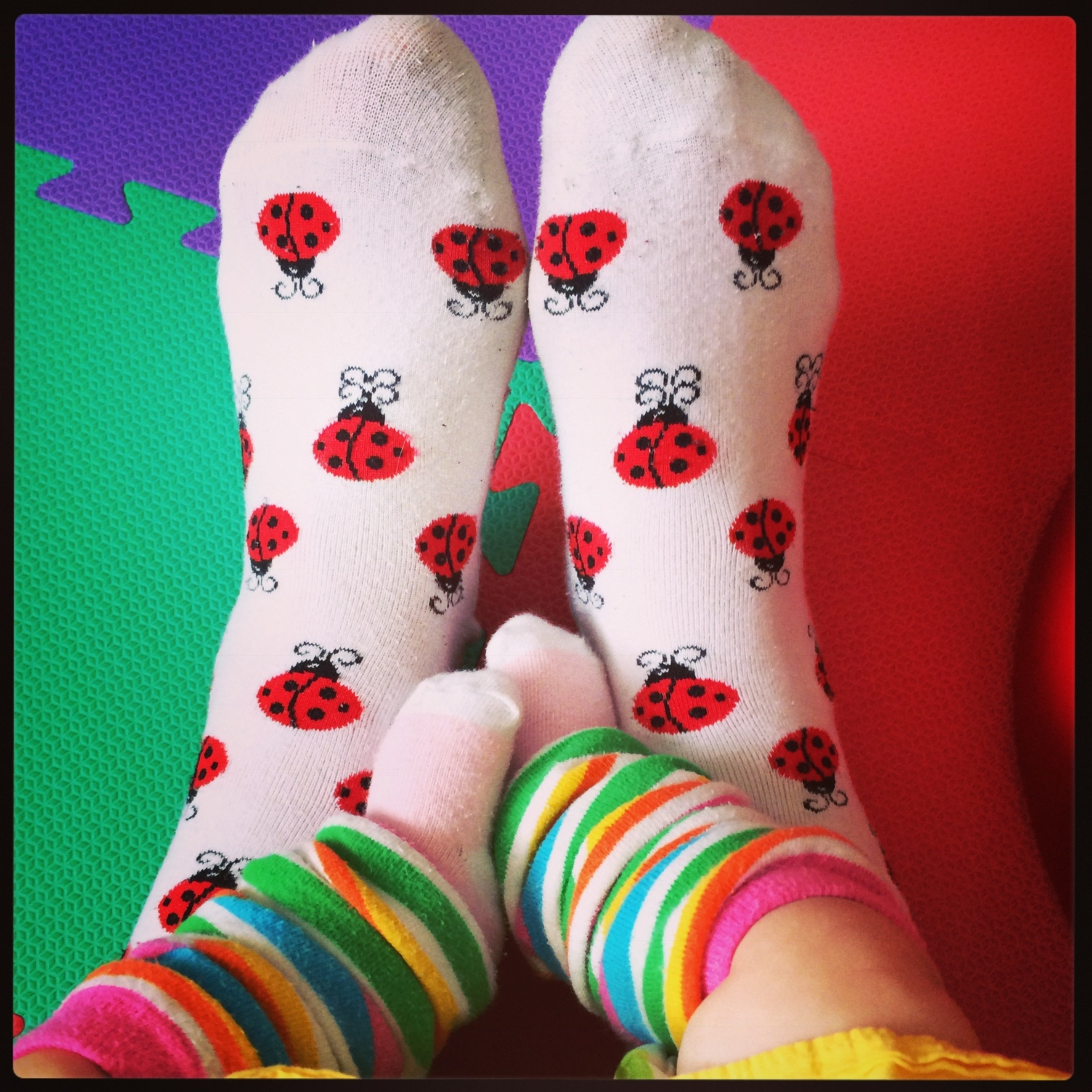
A typical person has 46 chromosomes; from each parent, we get one copy of chromosomes numbered 1-22, plus a sex chromosome. In the vast majority of cases (about 95%), a child with Down Syndrome has one extra copy of the 21st chromosome. The chromosomal difference occurs at conception. We refer to this as Trisomy 21 – three copies instead of two. This is why World Down Syndrome Day is on March 21 – 3/21 – get it? 😄 We wear wacky or mismatched socks in WDSD because chromosomes look kind of like socks, and on WDSD we celebrate and embrace the differences that come along with not having quite the same “socks” as everyone else.
About 3-4% of children with Down Syndrome have “translocation Down Syndrome,” which means that the third copy of chromosome 21 is attached to a different chromosome. In some cases, this translocation is inherited from a parent who is a “balanced carrier” – they have two copies of chromosome 21, but one of them is attached to another chromosome. The chances of having a child with Down Syndrome increase in these cases, as the child may inherit both the one copy of the 21st chromosome that’s in the right place and the extra copy attached to the other chromosome. I think that’s roughly how it works – don’t quote me on this. It gets a lot more complicated, but this is the basic gist of it. If a child has translocation DS, the parents should be tested to determine whether they are a carrier.
In the remainder of cases (about 2%), the chromosomal difference occurs at a later stage. A typical zygote is conceived, but during the process of cell division, some of the cells wind up with an extra copy of the 21st chromosome and some do not. The two lines of cells divide into more cells like themselves, until you wind up with an adorable little baby who has some percentage of cells in their body with three 21s, and some percentage with typical chromosomes. We call this “Mosaic Down Syndrome.” A common misconception is that a child with mosaic DS is not as impaired as a child with full trisomy 21, or that a child who is less impaired must necessarily have mosaic Down Syndrome. The reality is that Down Syndrome involves a wide range of potential cognitive and medical issues, and in any case of Down Syndrome, some of them will be present and some will not. The impact of the extra chromosome on a person with mosaic Down Syndrome depends on a number of factors, including the percentage of cells involved and where those cells are located.
Have I left anything out?
Literature
Today’s question is a shorter one, so I may answer two today.
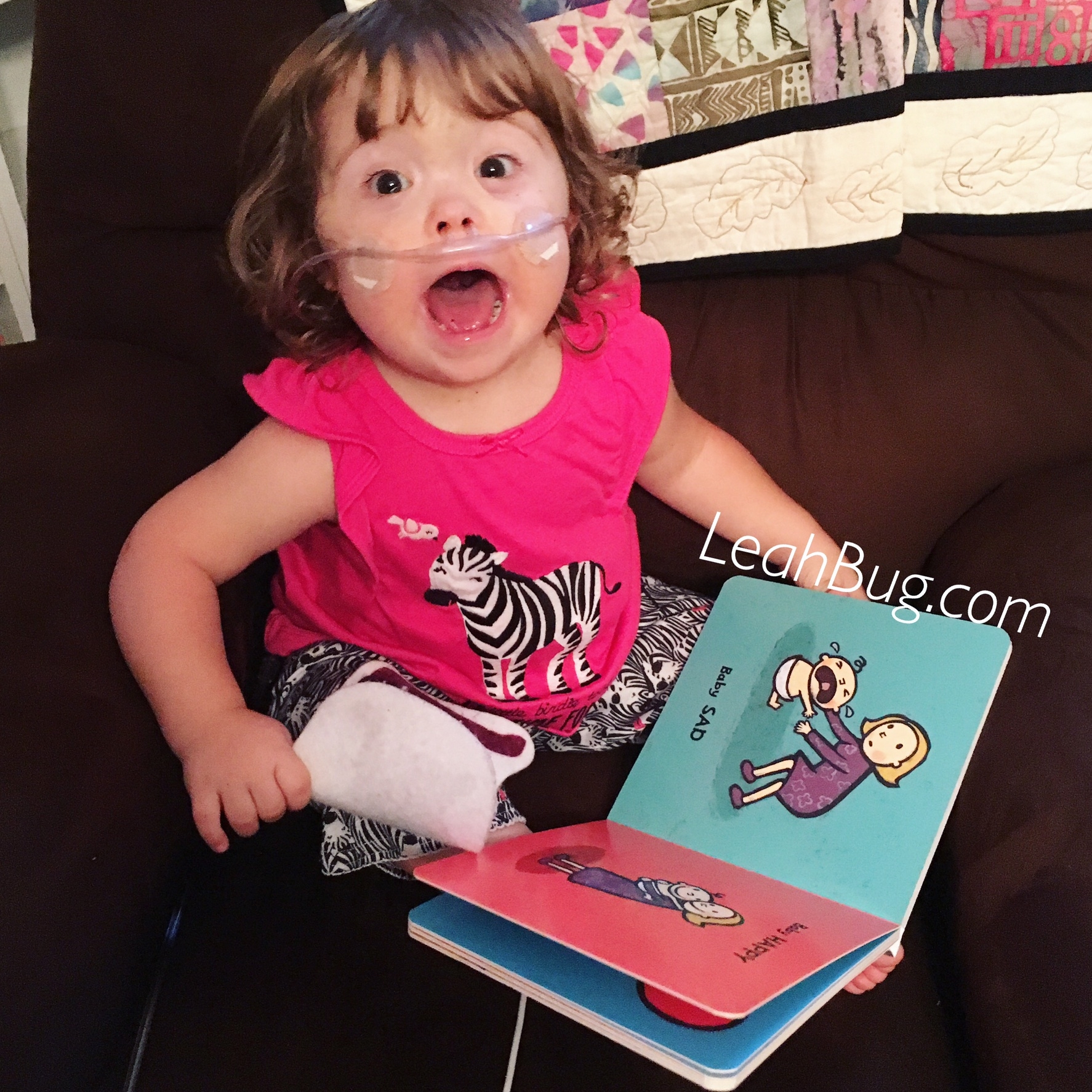
“Does Leah have a favorite book?”
Leah’s favorite book changes all the time, because she is a kid! We read to her every night as part of her bedtime routine, and have been doing so for years. Technically we started before she was born, when I read to her so she would hear my voice. 😹 When she was in the NICU, we read “Alice’s Adventures in Wonderland” to her – they were running a program encouraging parents to read to their preemies, and to record themselves so the nurses could play it back when parents weren’t there (like overnight) if the babies needed to be calmed.
Leah is a big fan of story time. For a long time, her favorite book was “The Very Hungry Caterpillar.” That’s when she was maybe 2 years old. She would make us read it five or six times in a row. Then it shifted to “Brown Bear Brown Bear What Do You See?” and she surprised us both by telling us what was coming on the next page the whole way through the book. She also LOVED the baby books by Leslie Patricelli, and would probably still read them if we brought them out. She still likes “The Runaway Bunny” and “Goodnight Moon,” although the latter is mostly outgrown. “The Cat in the Hat” is still going strong.
At age five, she still likes her simple little board books like “Gossie and Gertie” and the previously mentioned titles, but she also enjoys “Little Bear,” Daniel Tiger stories, Elephant and Piggy books, “The Family Book” by Todd Parr, and all sorts of books we have found for her.
For non-book story time, Leah enjoys recitations of her birth story, “The Walrus and the Carpenter,” and “The Fresh Prince of Bel Air.”
Challenges
Today’s question: What has been the hardest part of having a child with Down syndrome?
I have three answers to this question.
1) I’ll get the shortest one out of the way – it has been pretty difficult to resign myself to the fact that I will likely never have grandchildren. Women with Down Syndrome can have babies, but even if it were advisable developmentally for Leah as an adult, her unique health issues would likely get in the way of a safe pregnancy. That’s a hard pill to swallow, but it is what it is.
2) The uncertainty that comes along with all of Leah’s health issues can be very difficult. It’s not really clear how much can be attributed to Down Syndrome and how much can be attributed to Leah’s lottery-winning combination of health conditions, which is exceedingly rare even among children with Down Syndrome. Out of the hundreds or even thousands of families I’ve come across in person and on social media, I know of exactly one other child with the combo of Type A esophageal atresia, Down Syndrome, congenital heart defect, and Morgagni diaphragmatic hernia. But the comparatively higher risk of leukemia and the high risk of pneumonia are certainly both always in the back of our minds, especially during cold and flu season. And then there are all the usual fears that parents have – accidents, injuries, and the like. For kids with developmental disabilities there is also an increased risk of sexual abuse, partially because they are more vulnerable to manipulative adults, and partially because they often don’t have the words to communicate what has happened to them. And then there is the thought of what will happen to Leah if/when we are no longer here to take care of her. Public supports can only go so far, especially if the current regime gets its way. All in all, worry and uncertainty are a difficult part of having a child with a disability in general, not just Down Syndrome. And really, aren’t they a part of having children, period?
3) I would argue that the absolute hardest part of having a child with Down Syndrome is having to constantly confront assumptions about and low expectations for your child, especially when the people you’re confronting are the decision makers and gatekeepers for the services to which your child has access. I don’t understand why someone goes into special education if they believe that children with developmental disabilities don’t need a meaningful education. It baffles me. I don’t understand why agencies have to be on a race to the bottom as far as what services they provide. It makes no sense that parents ask for something to which their child is entitled and agencies say, “oh no, that’s not our policy.” Sorry, it’s not your policy to obey the law?
Along the same lines, it’s also appalling that vulnerable populations (people of color, immigrants, families with low income, non-English speakers, families with less access to information, and others) often have reduced access to services and supports. I see this happening all the time. This is especially true if they live in heavily underfunded school districts and catchment areas, but I think overall it’s mostly because agencies will say no to them just to see if they can get away with it. People with fewer social and economic resources are less likely to know their rights, and also less likely to be comfortable rocking the boat to get what they need. And sometimes agencies will rely on a person’s appearance, skin color, English language skills, or even age as a proxy for estimated knowledge of their child’s rights. One way to counter this tendency is for parents who have knowledge and experience with the system to network and share with parents who don’t. To this end, social media has been a major game changer, although it can’t fix everything. There are also nonprofits who do community outreach in multiple languages to advise families of available services and appeal rights. But the problem is still there.
I think that pretty much sums it up for me. Other parents can feel free to chime in. I do want to say that while raising a child with Down Syndrome is not all rainbows and unicorns, Leah is absolutely, without question, worth every second of it. I don’t ever want someone I know to get a prenatal T21 diagnosis and think to themselves, “Oh, but look how much they went through with Leah.” Raising a child is no picnic, regardless of ability. That’s just the reality of it. But Leah was exactly the child we were meant to have, and she is worth every hurdle we have to jump to help her reach her potential.
What is Down Syndrome?
I got three separate questions that can be folded into one response:
1) “What types of physical or mental conditions often accompany Down syndrome? And is there any difference in life expectancy because of Down itself?”
2) “Has anyone asked yet what Leah’s life expectancy might be? I know there’s no such thing as “typical”, especially when there are other factors besides T21 involved.”
3) “What characteristics are true of all/most Downs kids vs what things … Leah deals with [that] are due to another diagnosis or just to her uniqueness.”
Let me get the life expectancy question out of the way first, because it is the toughest to answer. Over the past few years I’ve had multiple people ask me, “So, is Leah out of the woods now?” And the truth is that with Down Syndrome, there is no such thing. We live in the woods. The woods never go away. A simple cold can be life-threatening. Pneumonia is common in our kids and hard to fight off. A tiny infection can lead to sepsis. Leukemia can strike at any time. I know too many parents whose children are no longer with them to speculate on Leah’s life expectancy. We take nothing for granted.
That being said, I will say that the *average* life expectancy of a person with Down Syndrome has doubled in the past fifty years or so, from about 25 to about 50. I would attribute that jump to two main factors: 1) improvements in pediatric cardiology and improved overall survival rates among infants with heart defects, and 2) deinstitutionalization. Living in the community and/or with your family translates to a longer life expectancy compared to living in a nursing home.
[Edit: Two corrections. First, average life expectancy is actually 60, not 50. But second, it’s important to note that the average life span for white people with Down Syndrome in America is significantly higher than that of non-white people with Down Syndrome. I would attribute this difference to disparities in access to adequate health care.]
As for common issues, I’ll try my best to list them, but it’s by no means comprehensive. Down Syndrome is a syndrome, which means there is a long list of potential issues and complications, but I don’t think there is any one thing that occurs in *every single child* with Down Syndrome except for the presence of the extra 21st chromosome. But for the most part, the physical characteristics you seen in *most* children with Down Syndrome include epicanthal folds leading to almond-shaped eyes, lower-set ears with small ear canals, a relatively flat nasal bridge, short stature, short fingers, and low muscle tone. Some things that are present in many cases are sandal-toe gap, simian crease (single crease) in the palm, a slightly curved pinky, small flecks in the iris of the eye (Brushfield spots), abnormal teeth, and I think sometimes a missing or underdeveloped 12th rib. Most children with Down Syndrome have some degree of intellectual delay, but this varies radically. On average, people with Down Syndrome have a mild to moderate intellectual disability.
Medically, there are many conditions that are more common in Down Syndrome, but that doesn’t mean they are always or even mostly present, and even though the conditions are more likely with Down Syndrome, the majority of children who have the conditions still have typical chromosomes.
And a child can be born with Down Syndrome and otherwise be in perfect health.
Nearly half of all babies with Down Syndrome are born with congenital heart defects. Not all of these will need surgery. Some will be holes that close on their own. Some may be closed by catheterization. Some will require open heart surgery or even reconstruction of chambers in the heart. Some of the babies with CHD also have pulmonary hypertension, although this is less common.
Our kids generally have a hard time fighting off infection. It’s not uncommon for a cold to develop into pneumonia.
Hearing and visual impairments are fairly common in Down Syndrome, and our kids are more prone to ear infections because of their small ear canals. Congenital hearing loss affects a smaller number of kids, but it’s still more common than in typical kids. Visual impairments include near and farsightedness, strabismus (crossing eyes), and nystagmus (shaking of the eye). Many of our kids will wind up with glasses at a young age.
Our kids are more prone to thyroid issues (especially hypothyroidism), celiac disease and other food sensitivities, and allergies. Sleep apnea is common and it’s not unusual for kids to have their tonsils and adenoids removed.
About 5% of kids with DS will be born with blockages along the gastrointestinal tract, including esophageal, duodenal and anal atresias. Esophageal atresia is particularly rare in general – about 0.5% to 1% will have EA, and only 7% of those will be Leah’s type (Type A). Another 1-2% of kids with DS will have Hirschprung’s disease, which is the absence of functional nerves in segments of the colon. These GI defects generally require surgical repair.
Low muscle tone can cause constipation and bowel issues in general. Low muscle tone and poor coordination are also responsible for the difficulties that our kids have with speaking and eating. I believe it’s partially responsible for the increased risk of aspiration pneumonia. It also makes our kids particularly bendy.
Kids with Down Syndrome are more likely to be dually diagnosed with autism and apraxia of speech, among other things.
About 1% of all people with Down Syndrome will develop leukemia.
By age 40-50, nearly all adults with Down Syndrome have the plaques in their brain that are present in Alzheimer’s disease, although they may not exhibit all of the symptoms. Of the adults with Down Syndrome who reach their 50’s-60’s, about half will have Alzheimer’s. These ages and numbers vary from source to source but they’re all pretty consistent within a given range. Scientists believe people with Down Syndrome may hold the key to new discoveries in Alzheimer’s disease.
Leah’s own medical history is pretty complicated, and it’s really hard to suss out what is related to Down Syndrome and what isn’t. Leah was born with Type A esophageal atresia (a particularly severe form), which occurs in roughly 2-5 infants with Down Syndrome per year in the US, depending on whether you use the lower estimates (2) or the higher ones (5). Leah’s heart defects were pretty clearly linked to the DS. She also had a congenital diaphragmatic hernia, a rare type called a Morgagni hernia. In this case the more rare type is less severe, so yay – although it had to be repaired three separate times. I believe the Morgagni type is more common in kids with DS, but don’t quote me on that. It’s still very rare.
Leah has temperature dysregulation, some of which could be attributed to her heart defects and some of which could not. She has severe motility problems along the whole of her digestive tract. Sleep apnea, thyroid issues, vision issues, and ear infections have also been at play. She has chronic lung disease as a result of being born 2 months early. She also has apraxia of speech.
The first time we took Leah to the genetics department, the doctor looked at her and looked at me and said, “this kid has more going on than any other child with Down Syndrome I have seen.” He also said he could not attribute several of her issues to the DS.
My working theory is that Leah may also have inherited my Ehlers Danlos Syndrome. It’s strictly a working theory because it’s very difficult to sort out hypermobility from EDS and hypermobility from Down Syndrome, among other things. The doc said he could not diagnose it at this time. However, it would explain her dysautonomic function issues, including motility and temperature regulation. It would also explain her recurrent hernia. I guess time will tell. I don’t think much would change regarding her treatment, so there is no rush.
Okay – I think I answered the questions? Did I forget anything?
On inclusion
This is the last question I have answered thus far. I intend to keep answering questions throughout the month, so if you would like to participate by asking questions, send me a message at Leah’s Facebook page, and I’ll add them to the list!
This question was asked for the specific purpose of being able to share the answer and responses with other professionals. If you want your response to be shared as well, comment on the post on Leah’s page.
Question: “What advice would you give to a teacher/coach (dance, karate, swim, cheer, football, theatre, etc) who would like to be more inclusive, but is afraid of “failing” the child or their family? I think there’s a lot of fear that comes along with inclusivity…fear of injuring the student, fear of offending the family, fear of not understanding the needs, fear of getting sued for one reason or another, fear of losing other clients because they don’t understand the additional needs or behaviors of other students in the class that may be seen as “distracting,” fear of not doing a good job, etc. I hear these fears often from people in extracurricular fields. The answer to these fears is knowledge. Please share your experiences and advice so we can help to remove those fears and create a more inclusive environment!”
So. Let me start with two stories to illustrate my feelings on this question.
1) As a person who suffered with chronic pain from an early age, I was never a very good student in physical education. Most of my P.E. teachers antagonized me and penalized me for my limitations, and made me resentful and resistant to participation – and in general they would mock students who performed poorly regardless of their physical health, making me even more self-conscious about my minimal athletic skill. The only decent grade I ever got in P.E. was from a teacher whose philosophy was that if she could see that you were making an effort to do your best, you would get a good grade in her class, regardless of your athletic skill. She was the only P.E. teacher who didn’t fail me (and now I’m not talking about grades).
2) At Leah’s summer camp, they closed out the session with a community basketball game, with campers (both with special needs and typically-developing) playing against adults from the community, including staff from the camp, police officers, and even professional basketball players. The game was absolutely adorable, but one thing I observed is that while the adults were very clearly letting the kids win the game, they were doing it in such a way that the children were still working really hard, individually and as a team, to earn that victory. So when they ultimately won, they could be proud of themselves for working hard and playing as a team.
For extracurricular activities, it is helpful to think about what the program is and what service it provides, and consider why parents enroll their kids in that program. In school, the measure of success is usually how many answers the child gets right, and whether the child conforms to specified academic standards. But in extracurriculars, the desired outcomes may not be so clear-cut.
In an art class, for example, is the goal to create masterpieces, or is it to acquire new skills and/or build on existing ones? Is the goal of joining a gymnastics class for small children to become competitive athletes, or to work on building coordination, strength and skill? In Girl Scouts, is the goal to become a star scout and earn every single badge in the book, or is it to give girls opportunities to build confidence and independence? In a children’s soccer league, what’s more important – winning the game, or learning how to play on a team?
Personally, I’m not thinking about whether Leah is going to become competitive in a given sport or activity – if she does, that’s great, but I’m enrolling her so that she can have fun and reap the benefits of the activity, e.g. exercise, improved coordination, team-building and cooperation, social interaction, new skills, etc. So my expectations for her are not going to be about how well she performs, but about what she puts into the class and what she gets out of it.
So I guess what I would ask from activity leaders here is that they demand the same amount of effort at participation, and self-discipline from Leah that they demand from the other children, and that they treat that as the bar for success.
I don’t want Leah to be babied and allowed to get away with poor behavior and minimal effort just because she has a disability. But I also recognize that she has limitations, and in certain situations, expecting the same *outcomes* from her as from the other kids is setting her up for failure. So I am not going to ask whether Leah’s cartwheels were as straight and flawless as the next kid’s cartwheels, or whether her craft project is as impressive. I’m going to ask whether she stood and waited for her turn as the other kids did, whether she listened to the teacher and did as she was instructed, whether she cheered for a classmate who gave a great performance, and whether she was a good team player. I’m also going ask whether Leah’s performance is improving from session to session, comparing her to herself rather than to other kids. And I’m going to ask whether she had fun.
As for the other children in the class or on the team? Three thoughts to consider here:
1) Consider that Leah might be able to model some good behaviors for other kids as much as they might be models for her. Maybe you have little kids in your class who have separation anxiety and panic when their parents leave. Maybe you have shy kids in your class who are afraid to approach others. Maybe your team members need to be reminded to say “please” and “thank you.” 🤷🏻♀️😄 Leah is here to help! And consider that Leah might really be great at whatever skill you’re teaching! Couldn’t you see her hamming it up in a theater class?
2) Psychologists have found that praising children’s effort and hard work is much more powerful than praising natural ability, and encourages kids to work even harder to reach their potential. This is true of children with low, average, AND high levels of ability or skill.
Having children with a variety of abilities in a class (whether they have special needs or just aren’t particularly athletic) is a good way for teachers and coaches to model that type of praise. It teaches kids to appreciate what they and their classmates and teammates can do instead of only focusing on their limitations, and it helps ensure that every child in the class reaches their personal potential. And it gives kids of all abilities the confidence to step outside their comfort zone with the knowledge that you will recognize that step as an accomplishment on its own, even if they aren’t able to achieve the desired outcome.
3) Ultimately, it is good for typically-developing children to see children with disabilities being treated with the respect they deserve, and being recognized as valued members of the team and the community. It’s good for kids with disabilities to be appreciated and respected and valued for their contributions. And it is good for all children to understand that being the absolute best at something isn’t necessarily always the greatest or only measure of success.
This is only my own opinion and perspective, and of course Leah is young, so I’m thinking primarily of classes for children her age. Other parents of kids with special needs, please feel free to chime in.

Keep calm – it’s only an extra chromosome
Here is the next question I answered: “I am wondering if Leah does know or will know she has Down Syndrome? How do people with Down Syndrome usually understand the condition?”
Answer: I think that you would see a range of answers to this question from different families, and the same is true for siblings’ awareness of Down Syndrome. In some families the parents really don’t discuss it at all until someone brings it up to them. In other families it is openly discussed and celebrated from birth. Some parents talk to their typical children about T21 before a sibling with T21 is born, and some have a conversation when big sibling is a little older. I imagine you will see choices being made at every point in between those different approaches.
For our family, the short answer is that we are really not sure how much Leah is aware of her differences. We talk openly about Down Syndrome in our house, read books that have photos of kids with Down Syndrome, and go to play dates with our local Down Syndrome community. Additionally, she spends a lot of time at clinic and at school with other children who have disabilities, so she sees children with a wide range of cognitive and physical abilities.
I think a more firm understanding of what Down Syndrome actually means will come when she is a little older and has the language capacity to articulate her feelings, and when she has spent more time around mostly typical children. But I always want to be open and positive about what makes Leah different as well as the ways in which she is the same as other kids.
I remember that one of the hardest things for me as a kid was knowing that I was different from my peers but not understanding why. It caused a lot of heartache and made me a target for bullying in a way that might have been different if I had been more aware of and confident in myself. I want Leah to have the confidence to say, “I have Down Syndrome, and I am awesome.”
If you want to hear some great young adult perspectives about living with Down Syndrome, I encourage you to watch the show “Born This Way” on A&E. Here are some other excellent videos:
“Things People Woth Down’s Syndrome Are Tired Of Hearing”
Feel free to chime in on this question, fellow parents of kids with Down Syndrome!

Prenatal diagnosis
Our first question: When did we find out that Leah had Down Syndrome?
Answer: We knew for certain at 23 weeks. Our second trimester state screen came out risk positive, and we opted for Non-Invasive Prenatal Testing (NIPT) instead of an amnio for confirmation. We actually had to do the 7-10 day wait twice, because the first company that ran our test wasn’t certified for our situation (reciprocal IVF). We had to do the process all over again with a new company. The test was returned with a 99.9% risk of Down Syndrome, and the other 0.1% was confirmed when the doctors repeatedly failed to locate Leah’s stomach on ultrasounds, indicating a blockage in the digestive tract, which is more common among kids with Down Syndrome.
As soon as we had confirmation of Leah’s T21 diagnosis, we went out and did a series of 4D ultrasounds, one immediately and one a month or two later. I believe this set of images came from the second set of ultrasounds, and it confirmed that Leah would be a little bug with a big personality.